
What a Virtual Power Plant Really Is (and Why Your Home Battery Might Start “Working for the Grid”)
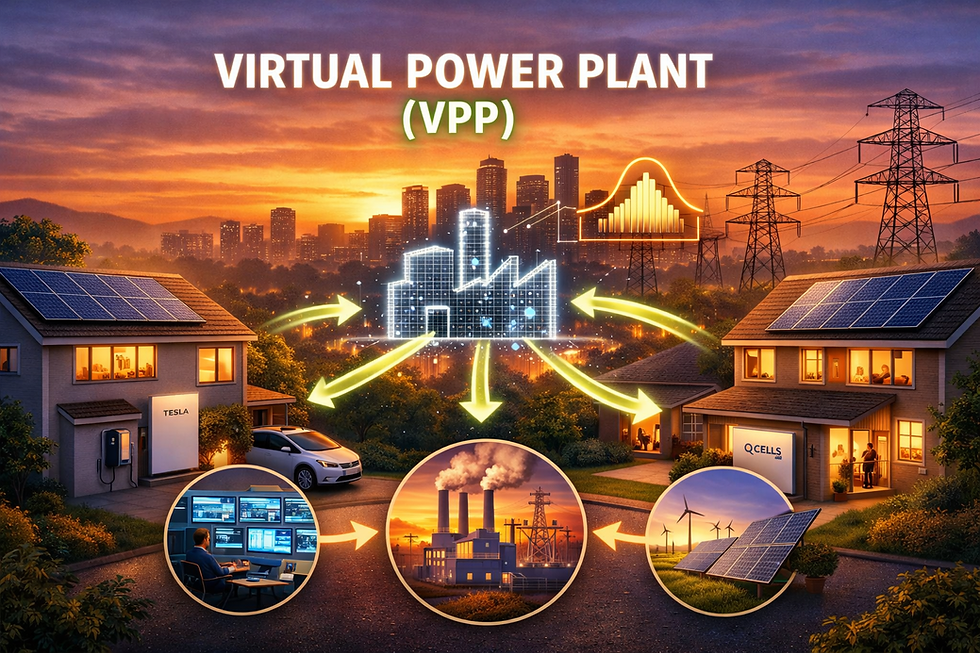
A Virtual Power Plant, often shortened to VPP, is not a power plant in the traditional sense. There is no single facility, no smokestack, and no large turbine producing electricity from one location. Instead, a VPP is a coordinated network of thousands of home batteries, solar systems, EV chargers, and smart energy devices that work together through software to support the electric grid when it is under stress.
For a homeowner, the concept is surprisingly straightforward. Your battery already stores energy for your own use. During periods when the grid needs help, usually on hot summer evenings when air conditioners are running and solar production is declining, your battery can briefly send energy back to the grid or reduce how much electricity your home pulls from it. When this happens across thousands of homes at the same time, the combined effect looks and behaves like a large power plant, even though the energy is coming from individual homes spread across a city or region.
This approach has become especially important in California, where electricity demand peaks in the late afternoon and evening just as solar generation fades. Virtual Power Plants help stabilize the grid without relying on expensive and polluting peaker plants, and homeowners are compensated for participating in the process.
From the homeowner’s perspective, participating in a VPP usually begins by enrolling through a battery manufacturer or an approved program partner. Once enrolled, your battery continues to operate as it normally would, offsetting time of use rates, powering your home, or providing backup during outages. The difference is that during specific grid events, software temporarily coordinates your system with thousands of others.
When a VPP event occurs, the battery may discharge for a short period of time, often one to two hours. These events are carefully managed so homeowners can maintain a reserve for outages if they choose. In return, participants receive financial incentives that may come as per event payments, seasonal credits, or performance based compensation tied to how much energy their system contributes. Participation is not constant or intrusive. Events are limited, tied to real grid needs, and designed to work within homeowner comfort settings rather than override them.
California is leaning into Virtual Power Plants because its energy landscape is changing quickly. As more homes adopt solar, electric vehicles, and electric appliances, the grid must handle sharper and more concentrated demand spikes. Building new traditional power plants and transmission lines is slow, expensive, and often controversial. Virtual Power Plants offer a faster and more flexible alternative by using energy assets that already exist in people’s homes.
For homeowners, this shift creates a new role in the energy system. Instead of being passive ratepayers, battery owners become active grid participants. Even in areas with relatively low electricity rates, participating in a VPP can still make sense. It is not just about chasing incentives. It is about increasing grid resilience and extracting more value from a system you already own.
Across California, Virtual Power Plant programs are already active, although they vary depending on the utility serving the home. Customers served by investor owned utilities such as Pacific Gas and Electric Company, Southern California Edison, and San Diego Gas & Electric may have access to VPP offerings tied to statewide grid support programs or manufacturer led enrollment pathways. These programs typically focus on summer peak events and emergency grid conditions.
Publicly owned utilities and community choice aggregators are also moving in this direction. Organizations such as Los Angeles Department of Water and Power and Sacramento Municipal Utility District have been expanding demand response and battery coordination programs that function much like Virtual Power Plants, even if they do not always use that exact label. As electrification accelerates, more municipal utilities and CCAs are expected to introduce similar programs, which means homeowners installing batteries today are positioning themselves for future participation even if a specific program is not available yet.
As Virtual Power Plants become more common, battery brand choice matters more than ever. VPP participation depends not just on hardware, but on software updates, utility coordination, cybersecurity compliance, and ongoing program eligibility. A battery platform that is not actively supported can fall out of compliance as program rules evolve, potentially limiting future participation.
This is one reason systems like the Tesla Powerwall 3 receive so much attention in the VPP conversation. Tesla operates one of the largest aggregated battery fleets in the world, which gives the company strong incentive to stay aligned with changing utility programs. As requirements shift, software updates help ensure existing customers remain eligible and continue to receive value from their storage investment. Tesla is not the only viable option, but it is a clear example of why long term ecosystem support matters.
Virtual Power Plants are not a short term experiment. They are becoming a core part of California’s energy strategy. For homeowners, this means batteries are no longer just about backup power or bill savings. They are about flexibility, resilience, and participation in a smarter, more adaptive grid.
Even if you do not enroll in a VPP immediately, installing a battery from a reputable manufacturer keeps the door open. As utilities and regulators refine these programs, homeowners who planned ahead will be in the best position to benefit.
At Renewable Innovations, we focus on helping homeowners understand not just what works today, but what will continue to work years into the future. That includes evaluating battery platforms, Virtual Power Plant eligibility, and how your utility’s long term direction may affect the value of your energy system, without pressure and without guesswork.


