
How Much More Solar Do You Need After Buying an Electric Vehicle?
One of the most common questions homeowners ask after switching to an electric vehicle is whether they now need more solar. In most cases, the answer is yes, but the good news is that EV charging is one of the easiest new electrical loads to plan for. Unlike many household appliances, vehicle charging is predictable, flexible, and often happens overnight during off-peak utility hours. When sized correctly, solar can absorb this new demand without overspending or leaving gaps in coverage.
The key is to start with the vehicle rather than the solar system. Electric vehicles consume energy in kilowatt-hours, just like a home, and understanding that consumption is the foundation of proper system sizing. Most modern EVs average between three and four miles per kilowatt-hour depending on vehicle size, driving style, and terrain. Smaller sedans tend to be more efficient, while trucks and larger SUVs use more energy per mile.
Consider a simple daily commute of forty miles round trip. At an average efficiency of three and a half miles per kilowatt-hour, that vehicle consumes roughly eleven to twelve kilowatt-hours per day. Over the course of a year, that adds up to approximately four thousand to forty-four hundred kilowatt-hours. For many households, that represents a twenty-five to forty percent increase in annual electricity use compared to pre-EV consumption. This is why adding an EV often changes the solar conversation so quickly.
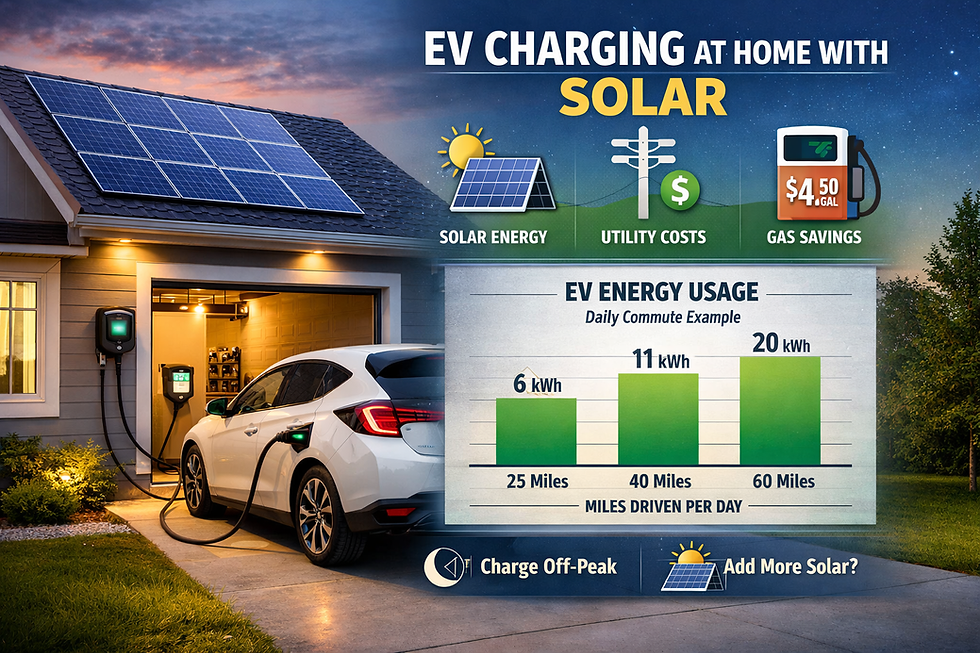
To put EV energy use into perspective, the table below shows common driving patterns and the corresponding electricity demand. These figures are simplified averages, but they are accurate enough for early planning and proposal review.
EV Energy Use Reference Chart
Daily Driving Distance | Average Efficiency | Daily EV Energy Use | Annual EV Energy Use |
25 miles per day | 4.0 miles per kWh | ~6 kWh | ~2,200 kWh |
40 miles per day | 3.5 miles per kWh | ~11 kWh | ~4,000 kWh |
60 miles per day | 3.0 miles per kWh | ~20 kWh | ~7,300 kWh |
That energy has to come from somewhere. It will either be supplied by your solar system, purchased from the utility, or covered by a combination of both. This is where a simple sizing shortcut can be helpful.
Using the Phi method as a rough baseline, one kilowatt of solar capacity produces about one thousand six hundred eighteen kilowatt-hours per year under average conditions. While this is not a substitute for professional modeling, it provides a useful sanity check. If your EV requires about four thousand kilowatt-hours per year, dividing that number by one thousand six hundred eighteen suggests roughly two and a half kilowatts of additional solar capacity. In practical terms, that often translates to six or seven modern panels in the four hundred to four hundred thirty watt range, or a slightly larger system if solar and EV planning are happening at the same time.
Charging method also plays a critical role in long-term cost control. While DC fast charging is useful for road trips, Level 2 charging at home is where EV ownership delivers the most value. A properly installed Level 2 charger adds roughly twenty to forty miles of range per hour, allowing most vehicles to fully recharge overnight. More importantly, Level 2 chargers allow scheduling around off-peak utility rates and solar production, which keeps operating costs predictable.
In California, off-peak electricity rates often range from twenty-five to thirty-five cents per kilowatt-hour, while peak rates can exceed forty-five or even sixty cents. An EV using four thousand kilowatt-hours per year could cost around one thousand to fourteen hundred dollars annually when charged off-peak, but that same usage could exceed two thousand dollars if charging consistently occurs during peak periods. As utility rates continue to rise, charging time matters just as much as charging speed.
When compared to gasoline, the economics still favor electric vehicles. A driver covering twelve thousand miles per year in a vehicle that averages twenty-five miles per gallon would consume roughly four hundred eighty gallons of fuel. At four dollars and fifty cents per gallon, that comes out to more than two thousand one hundred dollars per year. Even without solar, EV charging is often cheaper than gasoline. With solar, especially when paired with off-peak charging, much of that cost can be eliminated entirely.
Adding an EV after installing solar does not mean starting over. In most cases, a modest system expansion can offset one hundred percent of vehicle charging. Level 2 charging keeps energy use manageable, off-peak scheduling reduces exposure to time-of-use penalties, and solar future-proofs transportation costs as fuel prices and utility rates continue to climb. In regions like California, where refinery closures and grid pressure are ongoing concerns, this planning becomes less of a luxury and more of a long-term strategy.
The most important takeaway is to size once and size correctly. When you understand how your vehicle actually uses energy, solar sizing becomes straightforward and surprisingly affordable. Whether you already have solar or are planning both together, thoughtful design avoids overspending, prevents underbuilding, and delivers predictable results over time.
If you want help estimating EV energy use, planning a solar expansion, or selecting and installing a Level 2 charger, Renewable Innovations can help model the system properly from day one so there is no guesswork and no surprises later.


